
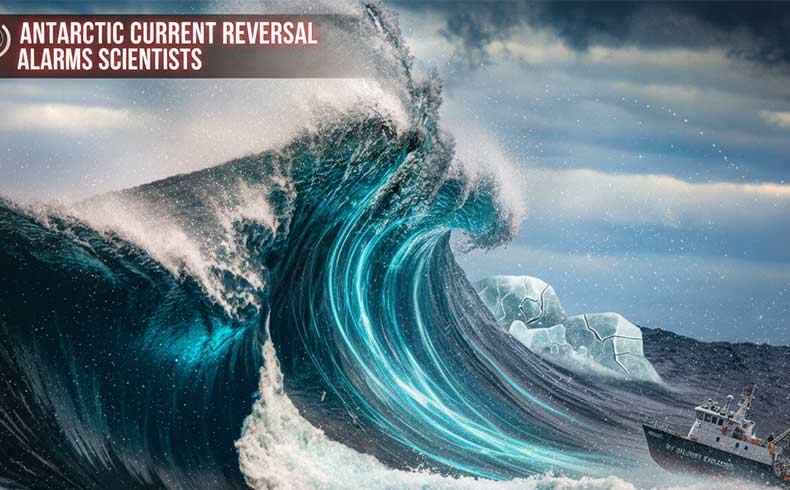
Antarctic Current Reversal: A Saline Surge Signals Global Alarm. Image Courtesy – Anandabazar
The impact of global warming on the ice in Antarctica is well known. The ice is melting every year. Statistics show that since 2015, the amount of ice that has melted in Antarctica and the adjacent seas is equal to the size of Greenland.
Antarctica’s sea ice is changing its character. The old rules no longer apply. The cold water that has been at the surface of the ocean for so long has suddenly started to move downwards. Instead, warm water rises from below. As a result, salt in the water of that part of the sea has also started increasing. Scientists have been worried since this change was noticed. Some claim that this could change the marine ecosystem. Some believe it will have a serious impact on other parts of the world.
This change in the dynamics of the ocean was first seen in the pages of data sent from artificial satellites in space. Britain’s National Oceanographic Centre (NOC) produced a report analysing data from multiple Earth-observing satellites. It is said there that the salt content of the water between the polar and subpolar currents in the sea adjacent to the continent of Antarctica has increased much more than normal. Scientists have also shown evidence that salt has been increasing since 2016. According to them, this salt increase is not possible unless there is a major change in the circulation of deep ocean currents in the Southern Hemisphere. Not just a change, but the circulation of ocean currents is thought to be completely reversed. As a result, the heat and carbon dioxide accumulated in the water at the bottom of the sea for hundreds of years are also coming to the surface.
Read: Scientists modified 350 years old concept that Sperms spin, not swim
The effect of global warming on Antarctic ice is more or less known. The ice is melting every year. Statistics show that since 2015, the amount of ice that has melted in Antarctica and adjacent seas is equal to the size of Greenland. It is one of the fastest changes in the world over the last few decades. According to the laws of science, when the ice melts, the salinity of the sea surface water decreases. This creates conditions that are favourable for re-glaciation. So the ice that melts and mixes with the seawater, that water is getting frozen again. Apparently, there is no possibility of any harm from it. But this calculation of the Antarctic Current is overturned by a sudden change in current flow. This change was completely unexpected for scientists.
Surface salt water has changed the nature of the ocean. Normally, ice-cold fresh water resides at the surface of the ocean. The water below it was relatively warm and salty. Salt controlled the flow of these waters. This would have ‘trapped’ the heat deep in the ocean and had cooler ice-forming water at the surface. But now the salt water is helping to bring heat up from deep in the ocean. This upward circulation of warm water is melting sea ice from below. There is no longer any chance of ice reformation. Scientists say that if this ‘trend’ continues, permanent changes may occur in the Southern Ocean. It can affect the entire world.
What problems could a sea change cause in remote, uninhabited Antarctica? Scientists claim, as a result, global ocean currents may be disrupted. Climate patterns can change. Also, aquatic ecosystems outside of Antarctica may be altered as a result. Although Antarctica is remote and uninhabited, there is no barbed wire in the water. All oceans are connected to each other. Some scientists believe that the ice that has started to melt due to global warming will accelerate the process of the Antarctic Current.
As the ice melts, the heat stored in the deep oceans is increasingly released into the Earth’s atmosphere. Scientists fear that climate change will accelerate, and more powerful storms will be created in different parts of the world. As a result, very cold and very hot weather will be experienced. The possibility of severe heat waves will increase more than before. The sea level has already started to rise as the ice melts. Scientists claim that, as a result of this, the habitat of penguins is also going to be endangered.